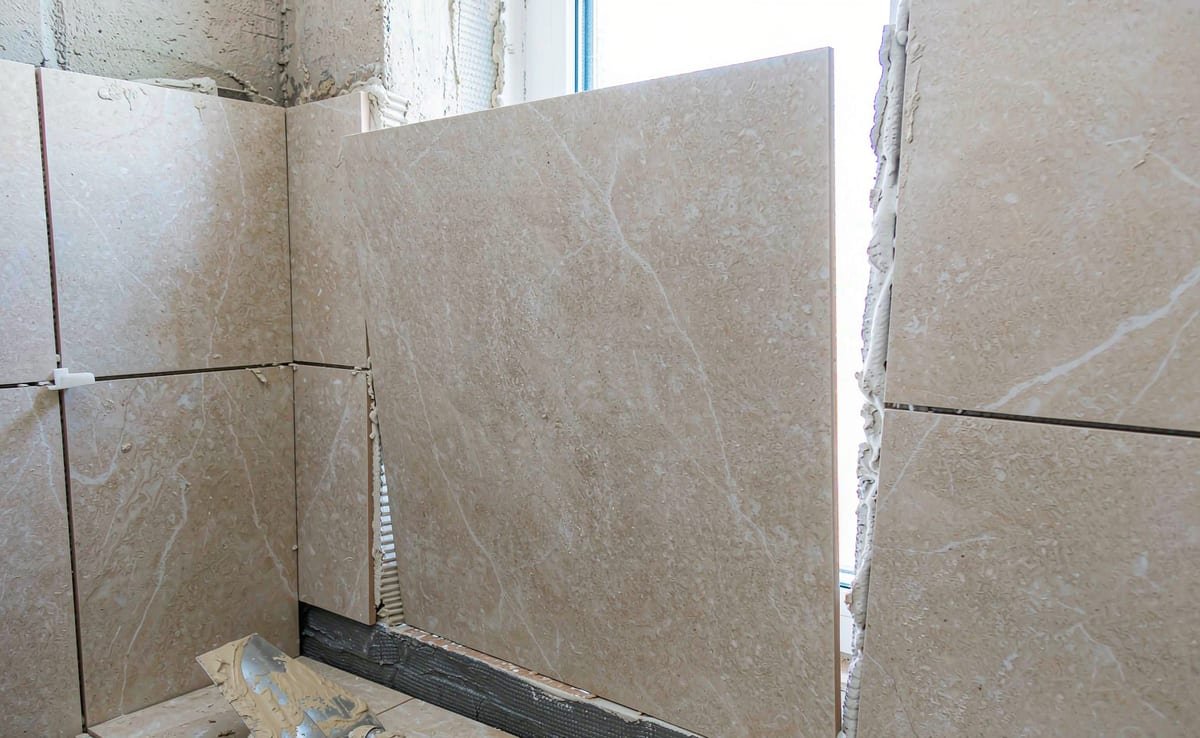
Slab sizes, thickness, mitred edges and book-matching — and the jobs where natural stone is still the right answer.
Large-format slabs changed what a kitchen can look like. A 3200×1600mm sheet means an island with no join, a full-height splashback with no grout line, and a shower with two panels instead of nine. The question is no longer whether to go large — it is which material to go large in.
What “large format” means in practice
The dominant slab size in the Australian market is 3200×1600mm, with thickness options that determine where the slab can go:
- 6mm — wall cladding, splashbacks, shower walls, and cabinet or door faces. Light enough to go vertically without heavy substrate work.
- 12mm — the workhorse for benchtops and most horizontal applications.
- 20mm — heavy-duty benchtops and the thickness that allows a substantial edge without mitring.
Why porcelain wins most of the time now
- Non-porous — no sealing, ever. Red wine, turmeric and lemon juice sit on the surface rather than in it.
- Heat and UV stable — a hot pan off the cooktop and sunlight through a north-facing window do not change the material.
- Stain resistance — the practical difference you notice in year five, not week one.
- Consistency — what you approved on the slab is what gets installed. No surprise at the vein that runs differently on the second slab.
- Weight — a 6mm porcelain panel is dramatically lighter than stone, which opens up applications stone simply cannot do.
For a family kitchen that will be used hard every day, this list is hard to argue with.
Where natural stone is still the right call
- Depth of veining — the light penetrates a marble or quartzite and reflects back from within. Printed surfaces come close; they do not match it.
- Repairability — stone can be re-honed and repolished in situ. A chipped porcelain slab edge means panel replacement.
- Thick edge profiles — a 40mm or 60mm stone edge is solid material, not a mitre.
- Uniqueness — no two blocks are the same, and some clients specifically want that.
The trade-off: stone needs sealing, marks more easily with acid, and needs an owner who accepts it will develop a patina.
Mitred edges and book-matching
A mitred edge is two slabs cut at 45° and joined, so the pattern folds over the edge and the benchtop reads as a solid block of material. It is the detail that makes a 20mm slab look like 40mm, and it is standard on waterfall ends.
Book-matching takes two consecutive slabs from the same block and mirrors them, so the veining opens like the pages of a book across the join. It is the most striking thing you can do with a slab, and the most demanding:
- It requires two slabs from the same block and batch.
- It adds significant wastage, because the mirror only works at one specific point on the slab.
- You must approve the actual pair, laid out, before fabrication.
Handling and fabrication
A 3200×1600mm slab is a two-person-plus job with suction lifters, moved on an A-frame rack. Cutting is done on a CNC or bridge saw with continuous water feed. This is not a material that tolerates improvisation on site — it is templated, cut off site, and delivered ready to install.
Build this into your programme: template happens after cabinets are installed and levelled, then fabrication is typically one to two weeks before installation. Plan the gap rather than discovering it.
How to choose
Ask what the surface has to survive. Heavy family use, direct sun, and an owner who does not want to think about sealing — porcelain. A showpiece island in a low-traffic kitchen, where the client wants depth and natural variation — stone. And always approve the slab you are actually getting.
See it in person: full slabs, large-format porcelain and engineered oak are on display at our Springvale showroom. Book a visit and bring your plans — we will measure your layout against the actual slab before you commit.